


Following a 15-year wheelchair tennis career that saw him scale the grandest of heights, Australian legend David Hall has been inducted into multiple Halls of Fame.
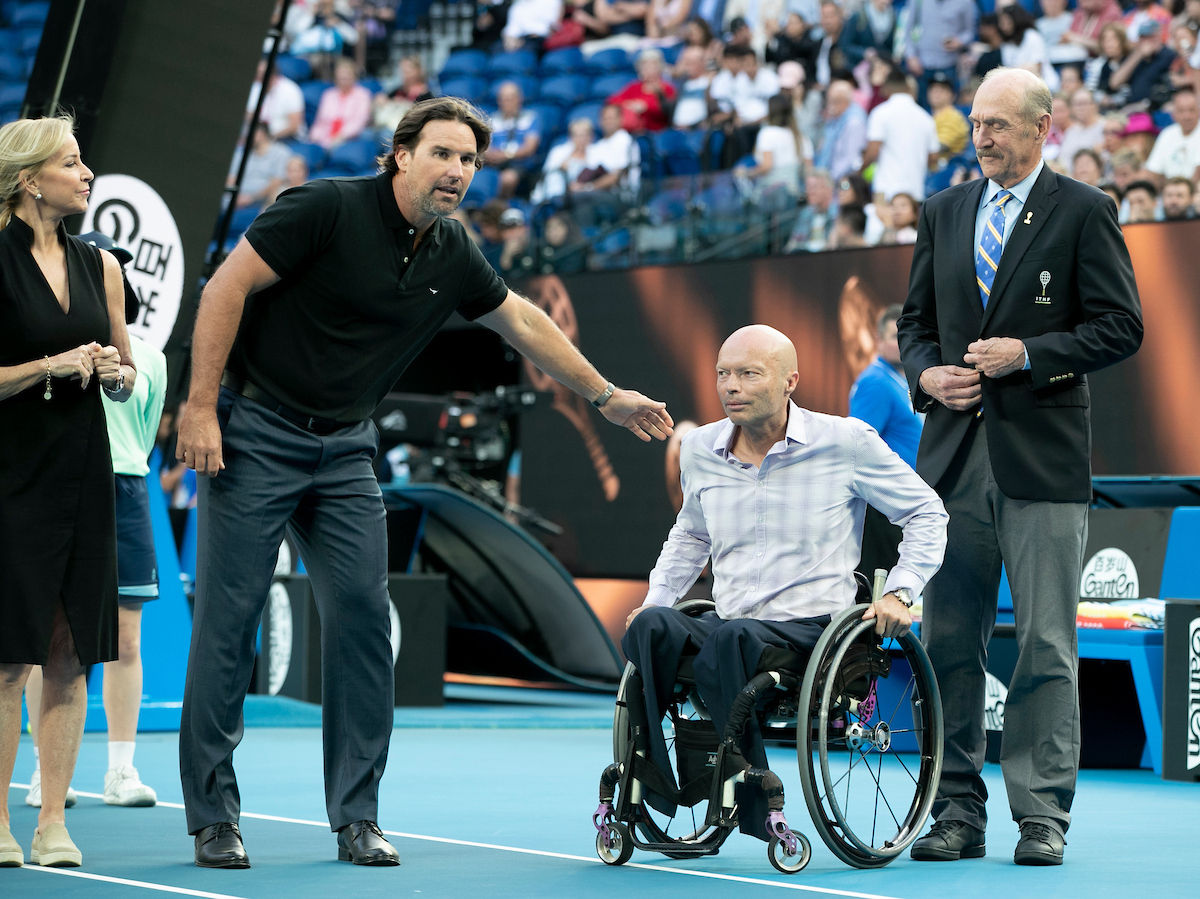
The most meaningful to him, he revealed in an interview on The Sit-Down podcast, was his inclusion in the Australian Tennis Hall of Fame in 2015. That honour saw a bronze bust, sculpted in his likeness, unveiled and positioned beside other legends of the sport in Melbourne Park’s Garden Square.
“That was magical for me,” said Hall, also a member of the Sport Australia Hall of Fame, International Tennis Hall of Fame, Australian Paralympic Hall of Fame and New South Wales Hall of Champions.
“It’s just so thrilling for me for it [my bronze bust] to be out there with Evonne Goolagong Cawley], and Newk [John Newcombe], and Rod [Laver], and Frank Sedgman, and Ken [Rosewall], and all these iconic tennis players who have just changed the fabric of Australian society in so many ways – and I’m out there with them.”
Of the 48 Australian Tennis Hall of Fame inductees, Hall is the only wheelchair tennis player among them, reflecting the impact he continues to have in this tennis discipline.
It’s a career journey he has detailed in his recently released autobiography Superbeast. Within its pages he covers his soaring highs on court and his vast array of unique experiences off it, while confronting the moment, as a teenager, he lost his legs after being struck by a car, forcing him to navigate a new reality in a wheelchair.
In Superbeast’s blurb, Hall states: “Despair can be lonely, but beyond it the sweetest things are the ones you don’t even know of yet, but only if you’re willing to find them.”
His discovery of wheelchair tennis – which came by way of an article in a local newspaper – helped him along his journey to acceptance. It also paved the way for a fulfilling, and legendary, sporting career.
“I was learning to walk with prosthetic legs, and then at some point along the way I discovered wheelchair tennis, which was fantastic, because whatever negative energy I had I could kind of pour into hitting tennis balls. And so at some point, all that negativity, and anger, and confusion, and ‘why me?’ just got left in the past.
From 1995, he was the leading men’s wheelchair player for the best part of a decade, winning nine Australian Opens, eight US Opens and seven British Opens, plus two Masters titles.
A six-time ITF World Wheelchair champion, Hall was a member of four winning Australian teams at the World Team Cup and also competed at three Paralympics – the zenith coming when he claimed singles gold at Sydney 2000.
“I just didn’t want to be remembered as the guy that couldn’t win gold, going in as the favourite in his own home town. The pressure was there,” Hall admitted.
Hall’s final Grand Slam appearance came at the 2005 US Open, the first time the tournament was staged at Flushing Meadows and integrated into the able-bodied event. In September 2025, he returned to New York for the first time to celebrate that 20-year anniversary.
Since then, Hall has worked as a coach and coaching consultant in Australia, served as a wheelchair tennis ambassador for the ITF, released Let’s Roll – a video tutorial series teaching people how to play wheelchair tennis – and promoted wheelchair tennis through visits to rehabilitation centres and other events.
He was recognised with the Brad Parks Award in 2015, a prestigious honour given to individuals or organisations who have made a significant international contribution to wheelchair tennis.
“I felt it was my responsibility to do [give back],” said Hall, who in parallel pursued his passion for writing, which culminated, after many years and four drafts, in Superbeast.
“Tennis was like this sweet carrot that I just wanted to taste year after year. And I was like: ‘I’ve eaten so many of these beautiful sweet carrots that I have to kind of reverse the situation. Now it’s my turn, I’ve got to give something to the sport.'"
READ: Meet Australia's tennis legends
It’s a sport Hall now observes as having grown exponentially through increased media exposure, TV coverage and prize money.
He had a taste of this new era when he won the 2003 and 2004 editions of the Australian Open – first integrated within the program of able-bodied events in 2002 – and playing that first US Open at Flushing Meadows. He’s excited for what may lie ahead for others who ultimately discover a sport that brought him so much.
“It used to be a pond. Now it’s a bigger lake. It’s turning into an ocean. It’s just getting bigger and bigger,” he observed.
“And who knows? We’re here at the 20-year anniversary [of the US Open’s integration] – what’s another 20 years going to be like down the track."
This story first appeared in Australian Tennis Magazine and has been adapted for online publication.
For more player features and up-to-date news, order your copy of Australian Tennis Magazine today.