
20 November 2025 | Adam Pengilly
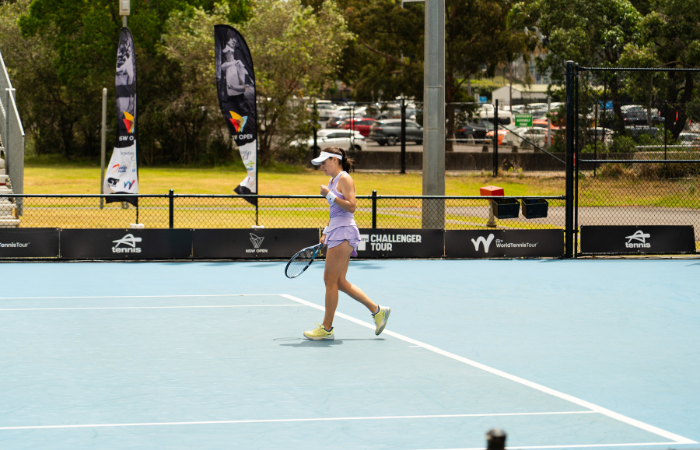
For an hour, maybe two, Kim Birrell is finally at peace.
She’s slaloming across the baseline, whacking forehands, backhands, this corner, that corner, knitting neat patterns until her opponent almost feels dizzy. The distractions, the noise, they’re all gone. If this is an athlete’s zone, can she stay in it forever?
“When I’m on court, it’s my one time during the day I don’t think,” Birrell says.
“It’s almost like meditation. I’m able to let everything else go and it’s just me and my opponent and the ball. I enjoy the challenge of getting the best out of myself. I don’t have to think about my phone and turning it off.”
Even at practice?
“That’s why I like practising too,” she shrugs. “I put the phone down and it’s just such a relief sometimes.”
It’s sobering, maybe a bit alarming, but the first thing most athletes do these days when they return to a locker room or change room, before they’ve even had time to swallow what a coach wants to say, is pick up their phone. Devices have just become a way of life.
But for almost 20 minutes on a warm day at Sydney Olympic Park during the Perpetual NSW Open, No.1 seed Birrell is yo-yoing through the highs and lows of a career which deserves celebrating.
Outside the tennis-devoted fans, how many of the Australian wider sporting public knew Birrell had climbed high enough in the world rankings to be Australia’s top female player earlier this year?
Humbly, she defers to injuries suffered by Ajla Tomljanovic and Daria Saville, and reasons her little slice of Australian tennis history would not have happened without their misfortune.
“But when I achieved that this year, I never thought that would ever happen,” Birrell says.
It’s not bad for a baby who was born in Dusseldorf in Germany because her father, John, was playing club tennis in Europe at the time. Her mother, Ros, was also a fanatic of the sport. Asked if she can remember at what age she started the game, the days for Kim all seem to blend into one another, because all she’s ever known was having a racquet in her hands.
When she was in primary school, her parents bought a run-down tennis academy on the Gold Coast. They didn’t have family there, but wanted to make it their life’s work to provide a place for others to play and learn the game. It’s still humming along at Southport.
Back in the day, former world No.4 Sam Stosur would pop in over the festive holiday period. A young Birrell would hit with her. Kim tried to absorb everything she could from Stosur, and life works in funny ways: she now plays under the grand slam champion for Australia’s Billie Jean King Cup side.
“I’ve told her now, but at the time she probably didn’t realise what an impact that made on me,” Birrell says. “When my parents went to build that academy back up, we were there every night, every weekend, Sundays my parents were working.
“When I was injured, I ended up spending so much more time there and that’s why I still have that love for the game. You see generations and how tennis affects so many people in a positive way. The people there just treat me like a normal regular person. I’m just Kim.
“I always look forward to going back there because I just grew up there in the tennis family.”
It’s hard to tell the Kim Birrell story without talking about the two crippling elbow injuries which kept her out of the game for a combined time of more than two years. Lesser people wouldn’t have found a way back, or even tried to find one.
She says, at one stage, she wasn’t sure if she would play again. She’s glad she did, and not just because she’s managed to win W75 titles in Fukuoka and Brisbane in the last couple of years, leading to her world ranking getting to 60.
“When I was injured, I let go of so many of those rankings goals and winning a grand slam goal I had growing up,” Birrell says. “I just wanted to be healthy and play. There was a time I wasn’t sure if I would.
“Once you have a surgery, your joint never goes back to the way it used to be. It just functions differently now. It affects certain things about my game with my serve and I need to manage my loads, but it’s just second nature now.
“It’s amazing how fast your expectations shift as well. When I got to top 100, I was like, ‘cool, it doesn’t seem like 80 is that far away now’. When I was 80, I quickly wanted to be top 50. We don’t always take the time to appreciate the journey and how hard it is was to get there. You’re always onto the next thing.”
For Birrell, the next thing will be preparing for the Australian summer and the first slam of 2026.
Having scrapped her way into the main draw through qualifying last year, she was handed an 11th-hour switch of opponent when the seeded Anna Kalinskaya withdrew – and it bamboozled her. She became emotional in the post-match press conference.
This time, she’s learning to be kinder to herself.
“The rollercoaster that was January has continued throughout the year,” Birrell says.
“I’m adjusting and I’ve always wanted to make the main draw of the Australian Open without receiving a wildcard without having to play quallies. If I can manage to do that, I’ll be so happy.”
Maybe then, she can pick up the phone. It will be the one time where she’ll happily be distracted telling friends and family about a new career first.
Latest

 NSW
NSW